 |
How It Works
If you’re not very familiar with a pressurized sprayer, here’s how it works:
1) Unscrew the combination carrying/pump handle from the top of the tank by twisting the handle in a counter-clockwise direction.
2) Pour in a measured amount of the chemical you plan to use, then add the appropriate amount of water to dilute the mixture according to the chemical manufacturer’s instructions.
3) Screw the handle/pump assembly back into the top of the sprayer in a clockwise direction, ensuring a snug fit.
4) Turn the pump handle enough so that it unseats from its stops and then pump the handle up and down to pressurize the tank. Approximately 20-30 strokes is normally sufficient to provide good spraying pressure.
5) Reseat the pump handle and you’re ready to spray!
In the spraying process, depress the handle on the flow control to release spray. Pressure in the sprayer forces the diluted mixture up the siphon tube, through the hose and flow control, and out of the adjustable nozzle.
Design Features
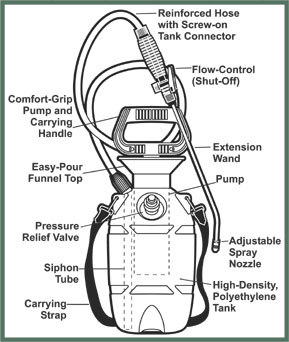
(Refer to drawing above for part names)
Tank: Originally steel, most modern sprayers have a tank of high-density, polyethylene. This material is tough, non-corrosive, light-weight, and is usually translucent, so you can readily see the level of fluid you’re adding to the sprayer.
Flow-Control (Shut-Off): Most RL Flo-Master sprayers feature a corrosion-resistant poly flow control, which has an ergonomically designed handle and grip, and a lock-on feature for extended spraying. Certain models will have a heavy-duty brass flow control, also with a lock-on feature.
Sprayer Top: Higher-end sprayers typically have a funnel top for ease of filling and pouring out left-over fluid; lower-cost sprayers have a straight neck.
Adjustable Spray Nozzle: Sprays a cone-shaped pattern which can be adjusted from a fine mist to a solid stream to reach high into trees or large bushes.
Pressure Relief Valve: Releases excess tank pressure if over-pumped; also useful to release pressure when you’re done spraying. Found only on certain models.
Carrying Strap: Typically found on 3 gallon capacity sprayers and on some, higher-end 2 gallon models.
Carrying/Pump Handle: Features the "Comfort Grip" design for ease of use and carrying, and wand storage slots to hold the extension wand/hose assembly in place while in storage.
Pump: The pump and integrated handle create air pressure inside the tank, which forces fluid out through the siphon tube and to the flow control.
Reinforced Hose: Heavy-duty, reinforced hose for long life. Screw-on tank connector simplifies assembly and maintenance of sprayer.
|
|
|


